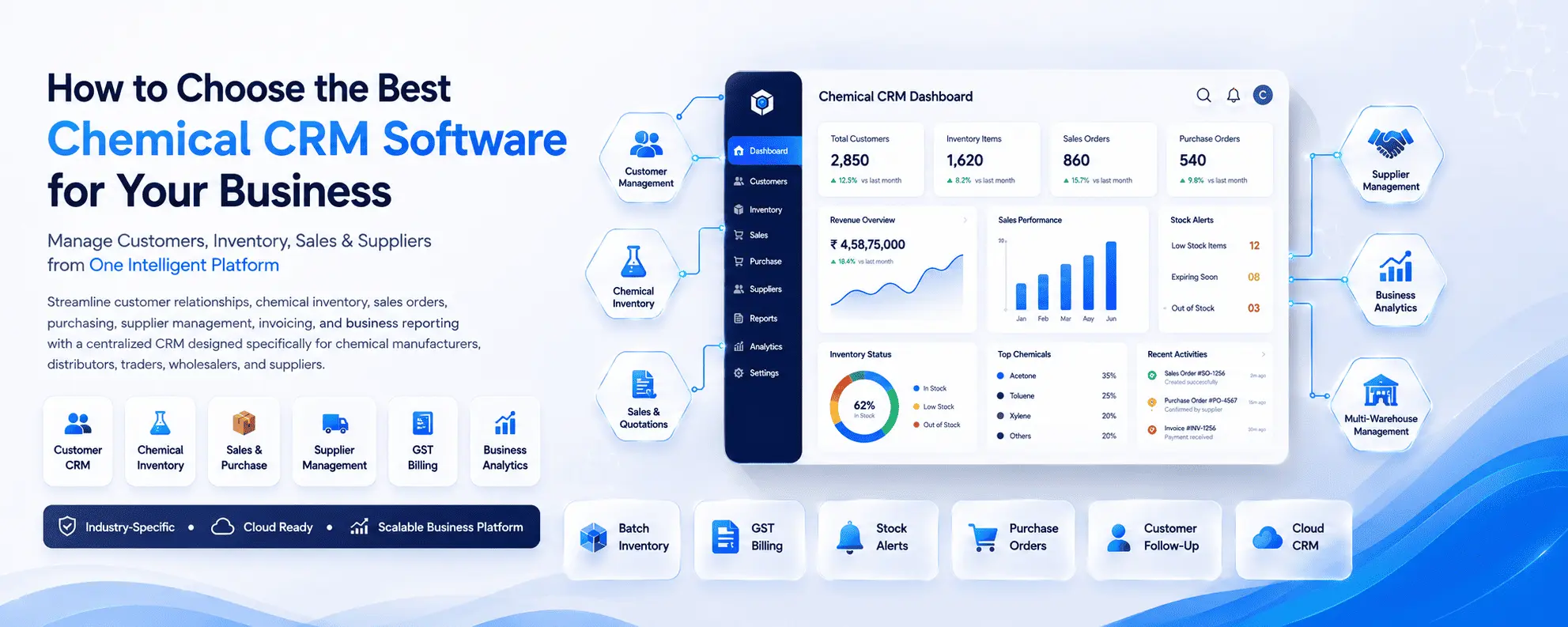
How to Choose the Best Chemical CRM Software for Your Business

MLGLOBTECH
Aug 4, 2026
The chemical industry operates in a highly competitive and regulated environment where managing customers, inventory, sales, suppliers, and compliance is critical for business success. Whether you are a chemical manufacturer, distributor, wholesaler, trader, or importer, relying on spreadsheets or disconnected software can lead to inventory errors, delayed deliveries, lost sales opportunities, and poor customer service.
This is where Chemical CRM Software becomes an essential business solution.
A modern Chemical CRM does much more than manage customer relationships. It integrates customer data, sales processes, inventory management, quotations, purchase orders, invoicing, supplier management, and reporting into one centralized platform. The result is increased efficiency, improved customer satisfaction, and higher profitability.
However, with numerous CRM solutions available, selecting the right one can be challenging. This guide explains the key factors to consider when choosing the best Chemical CRM software for your business.
What Is Chemical CRM Software?
Chemical CRM Software is a specialized business management solution designed specifically for chemical companies. Unlike generic CRM systems, it addresses the unique requirements of the chemical industry by combining customer relationship management with inventory control, sales management, purchasing, order processing, reporting, and business analytics.
The software enables businesses to:
Manage customers and suppliers
Track chemical inventory in real time
Handle quotations and sales orders
Manage purchases and stock
Generate invoices
Monitor business performance
Improve customer communication
Reduce manual work
Instead of using multiple disconnected systems, businesses can manage their entire operation from a single platform.
Why Your Chemical Business Needs CRM Software
The chemical industry involves thousands of products, varying quantities, multiple suppliers, complex pricing structures, and recurring customers.
Without an integrated CRM system, businesses often face:
Duplicate customer records
Inventory shortages
Overstock situations
Delayed order processing
Manual reporting
Poor customer follow-up
Sales tracking difficulties
A Chemical CRM eliminates these challenges by providing real-time visibility into every department.
Key Features to Look for in Chemical CRM Software
1. Customer Relationship Management
The CRM should provide a complete customer database including:
Customer profiles
Contact information
Purchase history
Payment records
Communication logs
Sales pipeline
Follow-up reminders
Having all customer information in one place enables your sales team to deliver better service and close deals faster.
2. Inventory Management
Inventory is one of the most important components of any chemical business.
Choose software that offers:
Real-time inventory tracking
Batch-wise inventory management
Stock availability
Low-stock alerts
Warehouse management
Product categorization
Stock movement history
Accurate inventory data prevents both stock shortages and excess inventory.
3. Sales Management
An effective Chemical CRM should simplify your complete sales process.
Look for:
Quotation management
Sales order processing
Price management
Customer-specific pricing
Order tracking
Invoice generation
Payment tracking
This helps sales teams respond quickly and improves customer satisfaction.
4. Purchase Management
Purchasing chemicals from multiple suppliers requires careful planning.
Essential features include:
Supplier management
Purchase orders
Goods receipt
Vendor history
Purchase reports
Pending purchase tracking
These capabilities improve procurement efficiency and reduce purchasing errors.
5. Supplier Management
Your suppliers play a critical role in business operations.
A good CRM should maintain:
Supplier profiles
Contact information
Purchase history
Product catalogs
Payment records
Performance tracking
This enables better supplier relationships and procurement decisions.
6. Reporting and Business Analytics
Business decisions should always be data-driven.
Choose software that provides dashboards and reports for:
Sales performance
Inventory valuation
Customer growth
Purchase analysis
Profitability
Outstanding payments
Top-selling products
Business trends
Real-time insights allow management to make informed decisions quickly.
Scalability Matters
Your CRM should grow alongside your business.
Ask yourself:
Can it handle multiple branches?
Can it support multiple warehouses?
Can new users be added easily?
Can additional modules be integrated later?
Does it support business expansion?
Selecting scalable software eliminates the need for costly migrations in the future.
Ease of Use
Even the most feature-rich software is ineffective if employees struggle to use it.
Look for:
Simple interface
Easy navigation
Fast search
Minimal training requirements
Mobile-friendly access
Quick data entry
User-friendly software increases employee adoption and productivity.
Integration Capabilities
Modern businesses use multiple tools.
Your Chemical CRM should integrate with:
Accounting software
Payment gateways
Email systems
SMS notifications
Barcode systems
GST billing
ERP modules
Integrated systems eliminate duplicate data entry and improve operational efficiency.
Data Security
Chemical businesses handle valuable customer and business information.
Choose software that provides:
Role-based access
User permissions
Data backup
Secure cloud or on-premise deployment
Audit logs
Encryption
Strong security protects sensitive business information and supports regulatory compliance.
Customization Options
Every chemical business has unique workflows.
Your CRM should allow customization of:
Sales process
Quotations
Invoices
Reports
Product categories
User roles
Business workflows
A flexible system adapts to your operations instead of forcing you to change established processes.
Customer Support and Training
Software implementation is only the beginning.
Choose a vendor that offers:
Technical support
User training
Software updates
Implementation assistance
Maintenance services
Quick issue resolution
Reliable support ensures smooth day-to-day operations.
Cloud-Based vs On-Premise CRM
When selecting Chemical CRM software, consider your deployment preference.
Cloud-Based CRM
Benefits include:
Remote access
Automatic updates
Lower infrastructure costs
Easy scalability
Data backup
On-Premise CRM
Benefits include:
Greater control over data
Internal server management
Custom infrastructure
Enhanced local security
Choose the option that aligns with your organization's IT strategy, budget, and compliance requirements.
Questions to Ask Before Buying Chemical CRM Software
Before making a decision, ask your software provider:
Is the software designed for chemical businesses?
Does it include CRM and inventory management?
Can it handle multiple warehouses?
Is GST billing supported?
Can it generate business reports?
Is training included?
What support is available after implementation?
Can the software be customized?
How secure is the system?
What is the total cost of ownership?
The answers will help you compare vendors effectively.
Why Choose MLGLOBTECH Chemical CRM Software?
MLGLOBTECH offers a comprehensive Chemical CRM solution designed to streamline business operations for chemical manufacturers, distributors, traders, wholesalers, and suppliers.
Key benefits include:
Customer Relationship Management
Real-Time Inventory Management
Sales & Purchase Management
Supplier Management
Invoice & Billing Management
Business Reports & Analytics
User-Friendly Dashboard
Secure Data Management
Customizable Modules
Scalable Solution for Growing Businesses
By consolidating customer management, inventory, purchasing, and sales into one platform, businesses can improve productivity, reduce operational costs, and deliver better customer experiences.
Conclusion
Choosing the right Chemical CRM software is a strategic investment that can transform how your business operates. The best solution should go beyond customer management by offering integrated inventory control, sales automation, supplier management, reporting, and analytics tailored to the needs of the chemical industry.
If you're looking for an all-in-one solution that helps streamline operations, improve customer relationships, and drive business growth, MLGLOBTECH's Chemical CRM Software is an excellent choice for chemical businesses of every size.
Frequently Asked Questions (FAQs)
1. What is Chemical CRM Software?
Chemical CRM Software is a business management solution that combines customer relationship management with inventory, sales, purchase, supplier, and reporting features specifically for chemical businesses.
2. Who should use Chemical CRM Software?
It is ideal for chemical manufacturers, distributors, traders, wholesalers, importers, exporters, and suppliers.
3. Can Chemical CRM software manage inventory?
Yes. Most modern Chemical CRM solutions provide real-time inventory tracking, stock alerts, warehouse management, and inventory reports.
4. Is Chemical CRM suitable for small businesses?
Yes. It helps businesses of all sizes automate operations, improve customer service, and scale efficiently.
5. How can MLGLOBTECH Chemical CRM help my business?
MLGLOBTECH provides an integrated Chemical CRM platform with CRM, inventory management, sales, purchasing, supplier management, invoicing, analytics, and customizable features to improve efficiency and support business growth.