AI-Powered QMS: How AI Simplifies ISO Compliance and Quality Management

MLGLOBTECH
Oct 14, 2026
Quality management is essential for organizations that want to maintain consistent processes, manage documentation, prepare for audits, and support continual improvement. For businesses following ISO standards, these responsibilities can involve extensive documentation, careful interpretation of requirements, and coordination across departments.
Traditional quality management processes often require significant manual effort. Quality professionals may spend hours preparing audit questions, drafting quality documents, reviewing ISO clauses, and searching through lengthy documents for relevant information.
An AI-powered Quality Management System can help simplify selected tasks by providing artificial intelligence assistance when users need it.
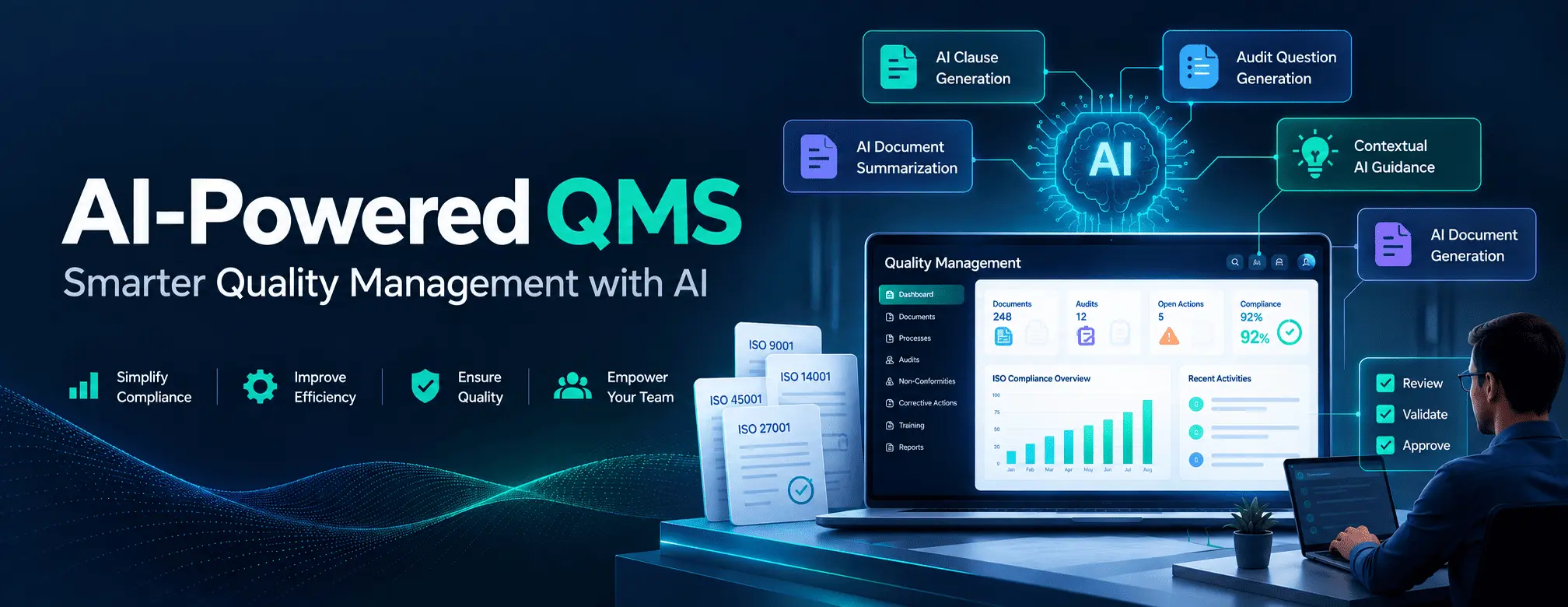
From generating draft ISO clause-related content and audit questions to providing contextual guidance, creating documents, and summarizing information, AI can help quality teams work more efficiently while keeping people involved in reviewing and approving important outputs.
In this article, we explore how AI can support quality management, practical examples of its use, and how ProQMS brings on-demand AI assistance to quality teams working with multiple ISO standards.
What Is an AI-Powered Quality Management System?
A Quality Management System is a structured approach to managing an organization's quality-related processes, documentation, responsibilities, and improvement activities.
A QMS can support activities such as document control, internal audits, non-conformance management, corrective and preventive actions (CAPA), risk management, and performance monitoring. The exact functionality depends on the platform.
An AI-powered QMS combines quality management functionality with artificial intelligence capabilities that assist users with selected tasks.
For example, instead of drafting every document from scratch, a quality professional may request an AI-generated draft. Instead of manually preparing every audit question, the user can ask AI to generate questions for review. AI can also help explain quality-related topics or summarize lengthy documents.
The main objective is to reduce some of the manual effort involved in preparing and reviewing information.
AI does not eliminate the need for professional judgment. Generated content must be reviewed for accuracy, completeness, and suitability before it is used in formal quality management activities.
Why Is AI Becoming Important in Quality Management?
Quality teams regularly work with standards, procedures, records, audit preparation, and documentation. These activities require attention to detail and a clear understanding of organizational processes.
AI can assist with specific information-related tasks in several ways.
1. Reducing repetitive drafting work
Preparing clause-related content, audit questions, and quality documents can involve repetitive writing. AI-generated drafts provide a starting point that users can review and adapt.
2. Supporting understanding of quality requirements
When a quality professional needs help understanding a quality-related concept, contextual AI guidance can provide an initial explanation for further review.
3. Simplifying document review
Long documents may contain information that takes considerable time to review. AI-powered summarization can help users understand the main points before examining the original document in detail.
4. Supporting quality professionals rather than replacing them
AI can assist with drafting, explanations, and summarization. However, people remain responsible for validating information, making quality decisions, and approving documents according to organizational procedures.
Five AI Capabilities That Can Support Quality Management
The usefulness of AI depends on how it is applied to real tasks. The following examples demonstrate how on-demand AI assistance can support quality professionals.
1. AI-Powered ISO Clause Generation
ISO standards contain requirements that organizations must understand and address within their applicable management systems. Quality professionals may need to prepare clause-related content for documentation, planning, or internal quality activities.
AI-powered clause generation can help users prepare draft content related to ISO clauses, reducing the need to begin every task from a blank page.
Practical example: Preparing for an ISO-related review
Imagine a quality manager preparing for an internal review of a process. The manager needs to organize clause-related information before discussing the process with the responsible department.
Rather than drafting all the supporting content manually, the manager can request AI assistance to generate a draft related to the relevant clause. The manager then compares the output with the official applicable standard and adapts it to the organization's actual processes.
Potential benefits
Provides a starting point for clause-related content.
Helps reduce initial drafting effort.
Supports the preparation of quality management materials.
Allows users to refine content according to organizational needs.
How ProQMS helps
ProQMS provides AI-assisted clause generation that users can trigger when they need assistance.
Important: AI-generated clause-related content is not a replacement for the official ISO standard. Users must verify the relevant requirements and edition before using the content.
2. AI-Generated Audit Questions
Audit preparation involves developing questions that help auditors examine relevant processes, responsibilities, records, and evidence.
Preparing these questions manually can take time, particularly when an organization manages multiple processes or works with multiple ISO standards.
AI-generated audit questions can give quality professionals an initial set of questions to review and customize.
Practical example: Preparing for an internal audit
Suppose a quality manager is preparing an internal audit for a department responsible for maintaining controlled procedures and records.
The manager requests AI assistance to generate draft audit questions related to the topic being reviewed. The questions provide a starting point for the audit preparation process.
Before using them, the manager checks whether the questions are relevant to the applicable requirements, the department's actual activities, and the objectives of the audit.
Potential benefits
Helps users begin preparing audit questions.
Reduces repetitive manual drafting.
Provides a starting point for organizing audit discussions.
Allows questions to be tailored to the organization's processes.
How ProQMS helps
ProQMS can generate audit questions using AI when users request assistance.
AI-generated questions should be reviewed by a competent person. They do not replace audit planning, auditor competence, objective evidence, or professional evaluation.
3. Contextual AI Guidance for Quality Teams
Quality professionals sometimes need clarification about a quality management concept or assistance understanding a topic relevant to their current task.
Contextual AI guidance can provide an explanation when users request it, helping them explore the topic before deciding what further review is needed.
Practical example: Understanding a quality management concept
Imagine a new quality team member who is preparing supporting material for an internal quality activity. The team member is unsure how a particular quality management concept relates to the task.
The user requests contextual AI guidance through the QMS. The response provides an initial explanation that the team member can discuss with the quality manager and compare with the organization's procedures.
This can help users approach unfamiliar topics with more context before proceeding.
Potential benefits
Helps users explore quality-related questions.
Provides an initial explanation of relevant concepts.
Supports learning and day-to-day quality activities.
Gives users assistance when questions arise.
How ProQMS helps
ProQMS offers AI-powered contextual guidance that users can request when they need assistance.
The guidance should be treated as supporting information, not as an authoritative interpretation of every ISO requirement. Important decisions should be validated against applicable standards, internal procedures, and qualified expertise.
4. AI-Powered Quality Document Generation
Documentation is an important part of quality management. Organizations may need to prepare and maintain procedures, instructions, and other quality-related documents according to their applicable requirements.
Creating documents from scratch can be time-consuming. AI-powered document generation can help users prepare initial drafts that can then be reviewed and adapted.
Practical example: Drafting a quality procedure
Suppose a quality manager needs to prepare a first draft of a procedure for a specific organizational process.
The manager uses AI document generation to create an initial draft based on the task and the information provided. The manager then checks whether the draft accurately reflects the organization's responsibilities, process steps, records, and working practices.
After the required revisions, the document can proceed through the organization's normal review and approval process.
Potential benefits
Provides a starting point for document preparation.
Reduces repetitive writing effort.
Helps users organize information into a draft.
Supports faster preparation of material for human review.
How ProQMS helps
ProQMS provides AI-powered document generation, allowing users to request assistance when preparing documents.
AI-generated documents should not be adopted without review. They must reflect actual organizational practices and be approved through the applicable document control process.
5. AI-Powered Document Summarization
Quality professionals may need to review lengthy documents to understand the main points, prepare for discussions, or determine which sections require closer examination.
AI-powered document summarization can condense information into a shorter overview, helping users review the general content more efficiently.
Practical example: Reviewing a lengthy quality document
Imagine a quality manager needs to review a lengthy document before a departmental meeting.
The manager requests an AI-generated summary to obtain an overview of the document's main points. The summary helps the manager identify sections that may need further attention.
When a specific requirement, exception, or detailed statement matters, the manager returns to the original document to verify the information.
Potential benefits
Helps users obtain an overview of lengthy documents.
Supports preparation for meetings and reviews.
Makes it easier to identify topics that need closer examination.
Reduces some of the effort involved in an initial document review.
How ProQMS helps
ProQMS includes AI-powered document summarization that users can trigger when they need a concise overview of document content.
A summary may omit important qualifications or details. The original document remains the authoritative source when complete information is required.
How On-Demand AI Assistance Fits into a QMS
AI is not required for every quality management task. Some activities depend on established procedures, assigned responsibilities, controlled records, and formal approvals.
On-demand AI assistance allows users to request help for specific tasks when needed, rather than assuming that AI operates continuously or makes decisions independently.
A typical AI-assisted process may follow these steps:
Identify the task: The user needs clause-related content, audit questions, contextual guidance, a document draft, or a summary.
Request AI assistance: The user triggers the relevant AI capability.
Review the output: The user checks the response for accuracy, relevance, and completeness.
Adapt the result: The user adjusts the content to reflect the organization's context and requirements.
Follow the approval process: Any information intended for formal use proceeds through the organization's applicable review and approval procedures.
This approach keeps quality professionals involved throughout the process. AI provides assistance, while the organization remains responsible for evaluating and using the results.
AI-Powered QMS for Multiple ISO Standards
Organizations may follow different ISO management system standards depending on their industry, processes, customer expectations, and business objectives.
When choosing a QMS, organizations should determine whether the platform supports the specific standards and editions relevant to their needs.
AI can assist with selected preparation tasks across quality management activities, including clause-related content generation, audit question generation, contextual guidance, document generation, and document summarization.
ProQMS supports multiple ISO standards, with additional standards planned for future expansion. Its AI capabilities provide on-demand assistance for the five tasks discussed in this article.
Before selecting a platform, organizations should confirm the availability of the required standard, edition, and functionality.
Supporting a standard within a QMS does not automatically mean that an organization complies with that standard. Compliance depends on the organization's processes, implementation, records, evidence, and applicable assessment requirements.
AI in Quality Management: Benefits and Limitations
AI can make selected tasks more efficient, but its output must be used appropriately.
AI capabilityPotential benefitImportant considerationClause generationHelps prepare draft clause-related contentVerify against the applicable official standardAudit question generationProvides a starting point for audit preparationTailor questions to the process and audit objectivesContextual guidanceHelps users explore quality-related topicsValidate important guidanceDocument generationHelps prepare initial draftsReview, adapt, and approve documentsDocument summarizationMakes lengthy information easier to reviewCheck the original when details matter
AI-generated information may be incomplete, inaccurate, or unsuitable for a particular context. It should be treated as assistance rather than proof of compliance.
Organizations should also consider data confidentiality before submitting sensitive information to an AI-enabled system. Review the platform's data handling practices, access controls, and relevant organizational policies before using confidential documents.
What Should You Look for When Choosing an AI-Powered QMS?
Choosing a QMS requires more than comparing AI features. Organizations should evaluate whether the platform supports their quality management requirements and working practices.
1. Support for applicable ISO standards
Confirm that the platform supports the standards and editions relevant to your organization.
2. Clearly defined AI capabilities
Look for specific, understandable capabilities such as clause generation, audit question generation, contextual guidance, document generation, and document summarization.
3. Human review and validation
AI-generated content should be available for review and suitable for adaptation to internal procedures and actual operating conditions.
4. Core quality management functionality
Evaluate the platform's support for the quality processes your organization needs, such as document control, audit management, non-conformance management, CAPA, and risk management. Verify the availability and scope of each feature with the provider.
5. Security and data handling
Consider access permissions, confidentiality, document handling, and your organization's information security requirements.
6. Future product development
Assess whether the provider's current capabilities and product roadmap align with your future needs. Distinguish features available today from functionality that is still planned.
Introducing ProQMS: AI Assistance for Quality Management
ProQMS is a Quality Management System designed to help organizations manage quality-related activities and work with multiple ISO standards.
Its AI capabilities focus on providing assistance for specific tasks when users need it.
With ProQMS, users can request:
AI clause generation to prepare draft content related to ISO clauses.
AI audit question generation to create draft questions for review and audit preparation.
AI contextual guidance to explore quality-related topics.
AI document generation to prepare document drafts for further refinement.
AI document summarization to obtain concise overviews of document content.
ProQMS supports multiple ISO standards, with additional standards planned for future expansion.
By combining QMS functionality with on-demand AI assistance, ProQMS aims to help quality professionals reduce some of the manual effort involved in drafting and reviewing information while keeping people involved in validation and decision-making.
AI-generated content should always be reviewed for accuracy and suitability before it is used in formal quality management activities.
Frequently Asked Questions
1. What is an AI-powered QMS?
An AI-powered Quality Management System combines quality management functionality with artificial intelligence capabilities that assist with selected tasks, such as generating draft content, preparing audit questions, providing guidance, and summarizing documents.
2. How can AI help with ISO compliance activities?
AI can help quality teams prepare clause-related content, generate draft audit questions, explore quality-related topics, create document drafts, and summarize information. The output requires human review and does not independently establish compliance.
3. Can AI generate ISO clauses and audit questions?
AI can assist with generating draft clause-related content and audit questions. Users should verify the output against the applicable official standard, organizational processes, and audit objectives.
4. Can AI create quality management documents?
AI can help prepare initial document drafts. The organization must review, adapt, and approve the documents according to its requirements and established procedures.
5. Does an AI-powered QMS guarantee ISO compliance or certification?
No. Using an AI-powered QMS does not guarantee ISO compliance or certification. Compliance depends on the organization's actual management system, implementation, evidence, and applicable assessment process.
6. Does ProQMS support multiple ISO standards?
Yes. ProQMS supports multiple ISO standards, with additional standards planned. Organizations should confirm that their specific standard and edition are supported.
7. Does ProQMS run AI processes automatically?
The AI capabilities discussed in this article are user-triggered. Users request assistance when needed, review the output, and decide how it should be used. These capabilities should not be interpreted as autonomous audits or independent quality management decisions.
8. Should AI-generated quality documents be reviewed?
Yes. AI-generated documents, clause-related content, audit questions, and guidance should be reviewed for accuracy, relevance, and alignment with applicable requirements before formal use.
Conclusion
AI is creating new opportunities to simplify selected tasks in quality management. From generating draft ISO clause-related content and audit questions to providing contextual guidance, creating documents, and summarizing information, AI can help quality teams reduce some of their manual workload.
However, AI is most useful when it supports rather than replaces professional judgment. Generated information needs to be validated, documentation must reflect actual organizational practices, and compliance decisions must remain grounded in applicable requirements and evidence.
An AI-powered QMS can be a valuable part of this approach when its capabilities match an organization's needs.
ProQMS brings on-demand AI assistance to quality management, supports multiple ISO standards, and continues to expand its capabilities.
Visit ProQMS to explore how an AI-enabled approach can support your quality management activities.