How a Quality Management System Helps Businesses Improve Performance

MLGLOBTECH
Aug 26, 2026
In today's competitive business environment, delivering consistent quality is essential for long-term success. Customers expect reliable products, efficient services, and positive experiences every time they interact with a business. At the same time, organizations must manage regulatory requirements, reduce operational errors, control costs, and continuously improve their processes. A Quality Management System (QMS) provides a structured approach to achieving these goals.
A Quality Management System helps businesses define, manage, monitor, and improve the processes that affect product and service quality. Instead of relying on disconnected documents, manual procedures, and individual decisions, organizations can establish standardized processes and maintain greater control over their operations.
What Is a Quality Management System?
A Quality Management System is a structured framework of processes, policies, procedures, responsibilities, and resources designed to ensure that an organization consistently meets quality requirements.
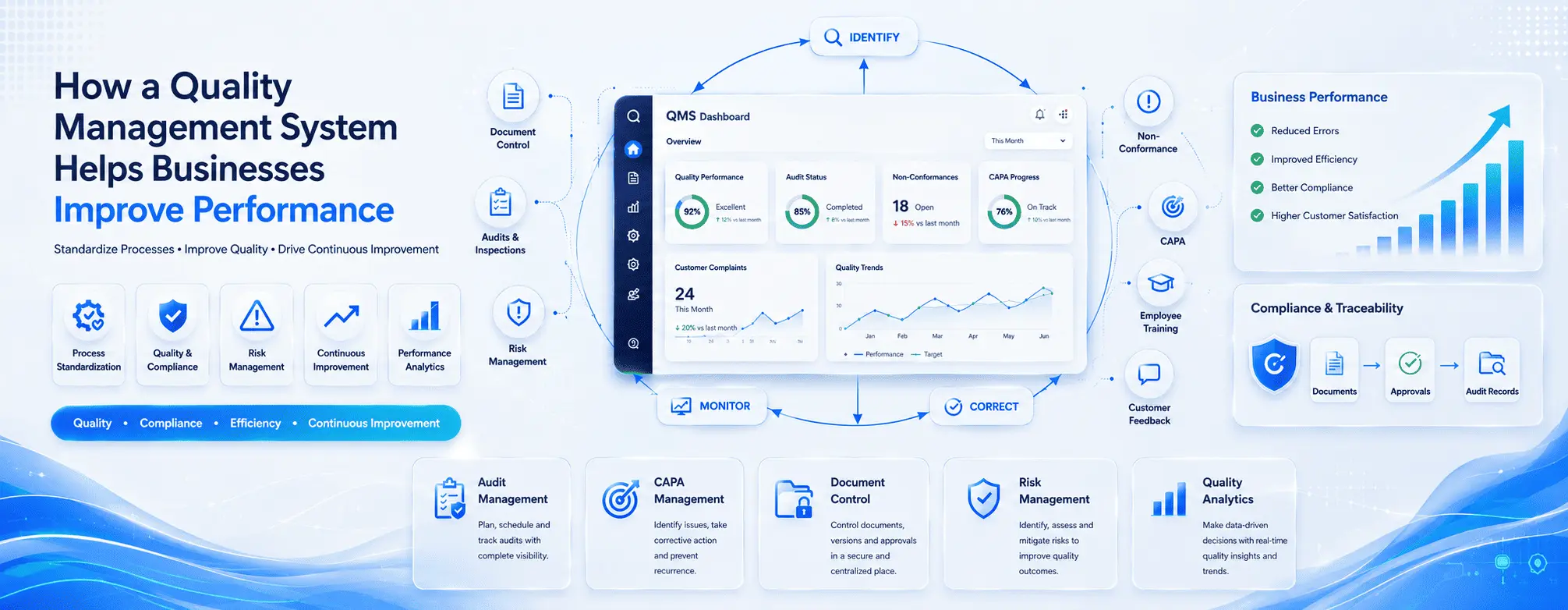
A modern QMS typically helps businesses manage areas such as:
Quality policies and objectives
Standard operating procedures
Document control
Employee training and competency
Risk management
Audits and inspections
Non-conformance management
Corrective and preventive actions (CAPA)
Customer complaints and feedback
Compliance requirements
Performance monitoring and reporting
The main purpose of a QMS is not simply to identify problems after they occur. An effective system helps organizations create repeatable processes, identify potential risks early, and continuously improve their operations.
1. Creates Consistent and Standardized Processes
One of the biggest ways a Quality Management System improves business performance is by creating consistency.
When employees follow different methods for completing the same task, the quality of the final result can vary significantly. This can lead to errors, delays, customer complaints, and unnecessary costs.
A QMS allows businesses to document and standardize important processes. Employees can access approved procedures and understand exactly how tasks should be completed. This reduces confusion and helps ensure that work is performed consistently across departments, teams, and locations.
For example, a manufacturing company can establish standardized procedures for production inspections. A service company can create consistent processes for handling customer complaints. In both cases, employees have clear guidance, reducing the dependence on individual knowledge or informal practices.
Standardization creates a stronger operational foundation and makes business performance more predictable.
2. Reduces Errors and Operational Waste
Errors can be expensive. A small mistake can result in product rework, wasted materials, missed deadlines, customer dissatisfaction, or compliance issues.
A Quality Management System helps organizations identify the root causes of problems instead of repeatedly fixing the same issues. When a non-conformance occurs, the business can document the problem, investigate why it happened, and implement corrective actions.
This structured approach helps prevent recurring errors.
For example, if a business regularly receives complaints about incorrect orders, a QMS can help investigate whether the problem is caused by poor documentation, inadequate employee training, system errors, or weaknesses in the order verification process.
Once the root cause is identified, the organization can take corrective action and monitor whether the solution is effective.
By reducing errors and waste, businesses can improve productivity while controlling operational costs.
3. Improves Employee Accountability
Clear responsibilities are essential for efficient business operations. When employees are unsure who is responsible for a process, important tasks can be delayed or overlooked.
A Quality Management System helps define roles, responsibilities, approvals, and workflows. Employees know what they need to do, managers can monitor progress, and important actions can be assigned to the appropriate individuals.
This improves accountability throughout the organization.
For example, when an audit identifies an issue, the QMS can assign a corrective action to a responsible employee, establish a due date, and track the status until the issue is resolved.
Instead of relying on emails, spreadsheets, or verbal follow-ups, businesses can manage quality-related tasks through a centralized system.
Greater accountability helps teams complete tasks on time and ensures that important issues do not get lost.
4. Supports Better Decision-Making
Business decisions should be based on reliable information rather than assumptions. A modern Quality Management System can collect and organize data from multiple quality processes, giving managers better visibility into business performance.
Organizations can monitor important indicators such as:
Number of customer complaints
Audit findings
Non-conformances
Corrective action status
Process performance
Product defects
Quality trends
Employee training completion
This information can help managers identify patterns and make informed decisions.
For example, if data shows that a particular process is responsible for an increasing number of defects, management can investigate the issue before it has a larger impact on customers or business operations.
Real-time dashboards and reports also make it easier to measure progress toward quality objectives.
5. Helps Businesses Manage Compliance
Many industries operate under strict quality and regulatory requirements. Managing compliance manually can be challenging, especially when businesses must maintain numerous policies, procedures, records, approvals, and audit documents.
A Quality Management System provides a more organized approach to compliance management.
Businesses can centralize important documentation, maintain version control, track approvals, and ensure that employees have access to the latest procedures. This reduces the risk of employees following outdated documents.
A QMS can also help organizations prepare for internal and external audits by maintaining records and providing better visibility into compliance activities.
For businesses in manufacturing, healthcare, pharmaceuticals, food production, technology, and other regulated industries, effective quality management can be an essential part of maintaining operational and regulatory requirements.
6. Enhances Customer Satisfaction
Customer satisfaction is closely connected to quality.
When businesses consistently deliver reliable products and services, customers are more likely to trust the organization and continue doing business with it. However, inconsistent quality can quickly damage a company's reputation.
A Quality Management System helps businesses focus on customer requirements and monitor customer feedback.
Complaints can be recorded, investigated, and analyzed to identify recurring problems. Instead of treating each complaint as an isolated incident, organizations can use customer feedback as valuable information for improving their products, services, and processes.
By continuously monitoring quality and addressing customer concerns, businesses can improve the overall customer experience.
Higher customer satisfaction can lead to stronger relationships, repeat business, positive reviews, and long-term growth.
7. Encourages Continuous Improvement
Successful businesses do not simply maintain their current processes. They continuously look for opportunities to improve.
Continuous improvement is one of the most important principles of an effective Quality Management System. Businesses can regularly review process performance, audit results, customer feedback, risks, and quality data to identify areas that need improvement.
The improvement cycle generally involves:
Identifying an issue or opportunity
Analyzing the root cause or current process
Planning an improvement
Implementing the necessary changes
Monitoring the results
Standardizing successful improvements
This approach helps organizations become more efficient over time.
Small improvements across multiple processes can create significant long-term benefits, including reduced costs, faster operations, improved quality, and greater customer satisfaction.
8. Improves Communication and Collaboration
Quality management involves multiple departments. Operations, management, employees, quality teams, and other stakeholders often need to work together.
Without a centralized system, communication can become fragmented across emails, spreadsheets, paper documents, and separate software tools.
A digital Quality Management System provides a central location for managing quality-related information and workflows. Teams can access relevant documents, receive notifications, assign tasks, and track progress more easily.
This improves collaboration and helps ensure that everyone is working with the same information.
Better communication reduces delays and makes it easier to resolve quality issues quickly.
9. Provides Greater Visibility Into Business Performance
Business leaders need visibility into what is happening across the organization.
A Quality Management System can provide centralized dashboards, reports, and performance data that help management understand where the business is performing well and where improvements are needed.
For example, management can monitor trends in audit findings, defects, complaints, or unresolved corrective actions.
This visibility allows businesses to move from reactive problem-solving to proactive quality management.
Instead of waiting for a major issue to affect customers or operations, managers can identify warning signs and take action earlier.
Conclusion
A Quality Management System is much more than a tool for managing documents or meeting compliance requirements. When implemented effectively, it becomes an important part of improving overall business performance.
By standardizing processes, reducing errors, increasing accountability, supporting data-driven decisions, managing compliance, improving customer satisfaction, and encouraging continuous improvement, a QMS can help organizations build stronger and more efficient operations.
Frequently Asked Questions (FAQs)
1. What is a Quality Management System (QMS)?
A Quality Management System (QMS) is a structured system that helps businesses manage, monitor, and improve their processes to ensure consistent product and service quality. It can include document control, audits, risk management, corrective actions, compliance tracking, and performance reporting.
2. How does a Quality Management System improve business performance?
A QMS improves business performance by standardizing processes, reducing errors, increasing employee accountability, improving decision-making, and supporting continuous improvement. It helps organizations identify problems early and take corrective action before they affect customers or operations.
3. What are the main benefits of using QMS software?
QMS software can centralize quality-related processes and information. Key benefits include improved document control, easier audit management, better compliance tracking, reduced operational risks, automated workflows, real-time reporting, and greater visibility into quality performance.
4. Which businesses need a Quality Management System?
A Quality Management System can benefit businesses of all sizes and industries. It is especially useful for manufacturing, healthcare, pharmaceuticals, food and beverage, technology, automotive, and other organizations that need to maintain consistent quality or comply with industry regulations.
5. What should businesses look for in Quality Management System software?
Businesses should look for features such as document management, workflow automation, audit management, non-conformance tracking, corrective and preventive action (CAPA) management, risk management, employee training records, dashboards, analytics, and customizable reporting. The software should also be scalable and easy for employees to use.