The Complete Guide to AI Chatbot Automation for Businesses

MLGLOBTECH
Aug 23, 2026
Businesses today are under constant pressure to respond faster, serve customers better, and reduce operational costs. Traditional customer support methods often depend on human agents to handle repetitive questions, collect information, process requests, and provide updates. As customer expectations continue to rise, businesses need smarter ways to manage these activities.
AI chatbot automation has emerged as an effective solution for automating customer communication and repetitive business workflows. AI-powered chatbots can interact with customers, answer questions, qualify leads, provide support, collect data, and connect users with the right resources—all with minimal manual intervention.
This complete guide explains what AI chatbot automation is, how it works, its benefits, important features, and how businesses can use it to improve productivity and customer experience.
What Is AI Chatbot Automation?
AI chatbot automation combines artificial intelligence, natural language processing, and workflow automation to create intelligent virtual assistants that can communicate with users.
Unlike traditional rule-based chatbots that can only respond to predefined commands, AI chatbots can understand natural language and provide more flexible responses based on the user's intent.
For example, a customer might ask:
“Can I track my order?”
The chatbot can understand the request, retrieve the relevant information from the connected system, and provide an automated response.
AI chatbot automation can also go beyond conversations. It can trigger business workflows such as lead collection, appointment scheduling, ticket creation, customer verification, notifications, and follow-ups.
How Does AI Chatbot Automation Work?
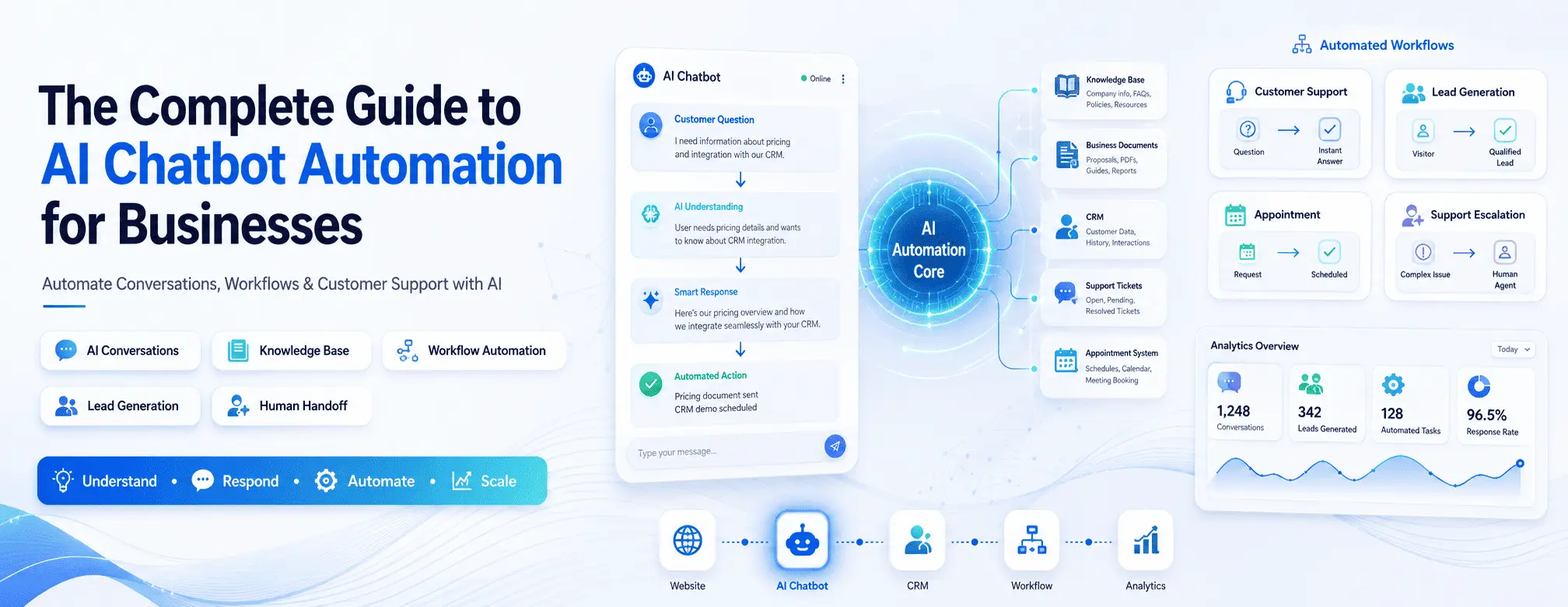
An AI chatbot automation system generally works through several steps:
1. Customer Interaction
The customer communicates with the chatbot through a website, application, messaging platform, or another supported channel.
2. Intent Recognition
The AI analyzes the customer's message and identifies what the user is trying to accomplish.
For example, it can distinguish between questions about pricing, product information, technical support, order status, or appointments.
3. Automated Response
The chatbot generates or selects an appropriate response based on the customer's request and available business information.
4. Workflow Automation
If the request requires an action, the chatbot can trigger an automated workflow. For example, it could create a support ticket, capture a lead, schedule an appointment, or send information.
5. Human Escalation
When a request requires human assistance, the chatbot can transfer the conversation to a support representative along with relevant customer information.
This combination of AI and automation allows businesses to handle routine activities automatically while allowing employees to focus on more complex tasks.
Key Benefits of AI Chatbot Automation
1. 24/7 Customer Support
One of the biggest advantages of AI chatbots is continuous availability. Customers can ask questions and receive assistance outside normal business hours.
This is particularly useful for businesses serving customers across multiple locations and time zones.
2. Faster Customer Responses
Customers expect quick responses. Long waiting times can negatively affect customer satisfaction.
AI chatbots can instantly respond to common questions, reducing the time customers spend waiting for support.
3. Reduced Repetitive Work
Support teams frequently handle repetitive questions such as:
What are your business hours?
How can I reset my password?
What is your pricing?
How can I track my order?
How can I contact your sales team?
Automating these common interactions allows employees to spend more time on important and complex tasks.
4. Improved Lead Generation
AI chatbots can work as automated lead-generation assistants.
They can ask visitors qualifying questions, collect contact details, understand their requirements, and forward qualified leads to sales teams.
Instead of simply displaying a contact form, businesses can create an interactive conversation that guides potential customers toward the next step.
5. Better Customer Experience
AI chatbots can provide consistent responses and guide customers through common processes.
When integrated with business systems, they can also provide personalized information based on customer requests.
6. Lower Operational Costs
Automating repetitive support and administrative activities can reduce the amount of manual work required from employees.
Businesses can potentially handle a larger volume of customer interactions without increasing support resources at the same rate.
Essential Features of an AI Chatbot Automation Platform
When selecting an AI chatbot automation platform, businesses should consider the following features.
Natural Language Understanding
The chatbot should understand conversational language rather than relying entirely on exact keywords or predefined commands.
Automated Workflows
A strong platform should allow businesses to create automated workflows for common tasks and customer requests.
Multi-Channel Support
Businesses may communicate with customers through websites, messaging applications, social platforms, and other channels. A centralized chatbot solution can help manage these interactions more efficiently.
Knowledge Base Integration
AI chatbots can use business information such as FAQs, product documentation, policies, and service information to provide relevant answers.
CRM Integration
Integration with CRM systems can help businesses capture and manage leads generated through chatbot conversations.
Analytics and Reporting
Analytics can help businesses understand chatbot performance, conversation volume, customer questions, response effectiveness, and areas where human support is still required.
Human Handoff
AI should not replace human support in every situation. A good chatbot solution should allow conversations to be transferred to human agents when necessary.
AI Chatbot Automation Use Cases
AI chatbot automation can be applied across many industries and departments.
E-commerce
Online stores can use AI chatbots to answer product questions, provide order updates, recommend products, and assist customers throughout the buying journey.
Healthcare
Organizations can use chatbots for appointment-related questions, general information, reminders, and basic administrative support, while ensuring sensitive matters are handled appropriately by qualified professionals.
Education
Educational institutions can automate responses about courses, admissions, schedules, application processes, and general student inquiries.
Real Estate
Real estate companies can use AI chatbots to capture buyer requirements, share property information, qualify prospects, and schedule appointments.
SaaS and Technology
Technology companies can automate frequently asked questions, product guidance, onboarding assistance, and initial technical support.
Events and Exhibitions
Event organizers can use AI chatbots to answer registration questions, provide event schedules, assist visitors, share exhibitor information, and automate attendee communication.
AI Chatbots vs Traditional Chatbots
Traditional chatbots generally depend on predefined rules and decision trees. They can be useful for simple questions but may struggle when users phrase requests differently.
AI chatbots are designed to understand conversational language and context more effectively.
For example, a traditional chatbot may require a customer to select “Order Status” from a menu. An AI chatbot can understand different questions such as:
“Where is my order?”
“Can you check my delivery?”
“I haven't received my package yet.”
This makes AI-powered chatbot experiences more natural and flexible.
How to Implement AI Chatbot Automation
Businesses should begin by identifying repetitive processes that consume significant employee time.
Next, define the chatbot's primary objectives. These might include customer support, lead generation, appointment scheduling, or workflow automation.
Then, prepare the information the chatbot will need, including FAQs, product details, policies, and business processes.
After implementation, businesses should monitor conversations and analytics regularly. This helps identify unanswered questions, improve workflows, and continuously enhance the customer experience.

Why Businesses Should Invest in AI Chatbot Automation
AI chatbot automation is no longer limited to answering simple customer questions. Modern solutions can become an important part of a company's customer service, sales, and operational workflows.
For businesses looking to implement their own branded solution, MLGLOBTECH's AI Chatbot Automation Platform can help automate customer conversations and business processes through an intelligent, customizable platform.
A white-label approach can also be useful for software companies, agencies, and technology providers that want to offer AI chatbot automation under their own brand.
Conclusion
AI chatbot automation provides businesses with a practical way to improve customer communication, automate repetitive tasks, generate leads, and increase operational efficiency.
The biggest value comes from combining AI-powered conversations with automated business workflows. Instead of simply answering questions, an intelligent chatbot can help customers complete tasks and connect conversations with business operations.
As businesses continue moving toward digital and automated customer experiences, AI chatbot automation is becoming an important technology for organizations that want to improve efficiency while delivering faster and more convenient customer service.
Frequently Asked Questions (FAQs)
1. What is AI chatbot automation?
AI chatbot automation uses artificial intelligence to automate customer conversations and business workflows. It can answer questions, collect information, generate leads, provide support, and trigger automated actions without constant human intervention.
2. How can AI chatbots benefit businesses?
AI chatbots can provide 24/7 customer support, reduce repetitive manual work, improve response times, generate leads, increase productivity, and deliver a more consistent customer experience.
3. Can AI chatbots integrate with business systems?
Yes. AI chatbot platforms can integrate with systems such as CRM, helpdesk, payment, scheduling, and other business applications to automate tasks and provide more personalized customer interactions.
4. What industries can use AI chatbot automation?
AI chatbot automation can be used across e-commerce, healthcare, education, real estate, SaaS, finance, travel, events, exhibitions, and many other industries for customer support, lead generation, sales, and workflow automation.
5. How can MLGLOBTECH help with AI chatbot automation?
MLGLOBTECH offers an AI Chatbot Automation Platform designed to help businesses automate customer communication and workflows. The platform can be customized and branded to support different business requirements and use cases.