Event Management Software Cost: Build vs. Buy a White-Label Platform

MLGLOBTECH
Oct 22, 2026
You are ready to launch an event management platform, but the quotations are difficult to compare. One covers development. Another includes a license and setup. A third looks affordable until you add integrations and transaction fees.
To understand event management software cost, you need to know what each price includes and what you will pay after launch. The right comparison starts with your business model, expected registration volume, and the work your team can realistically manage.
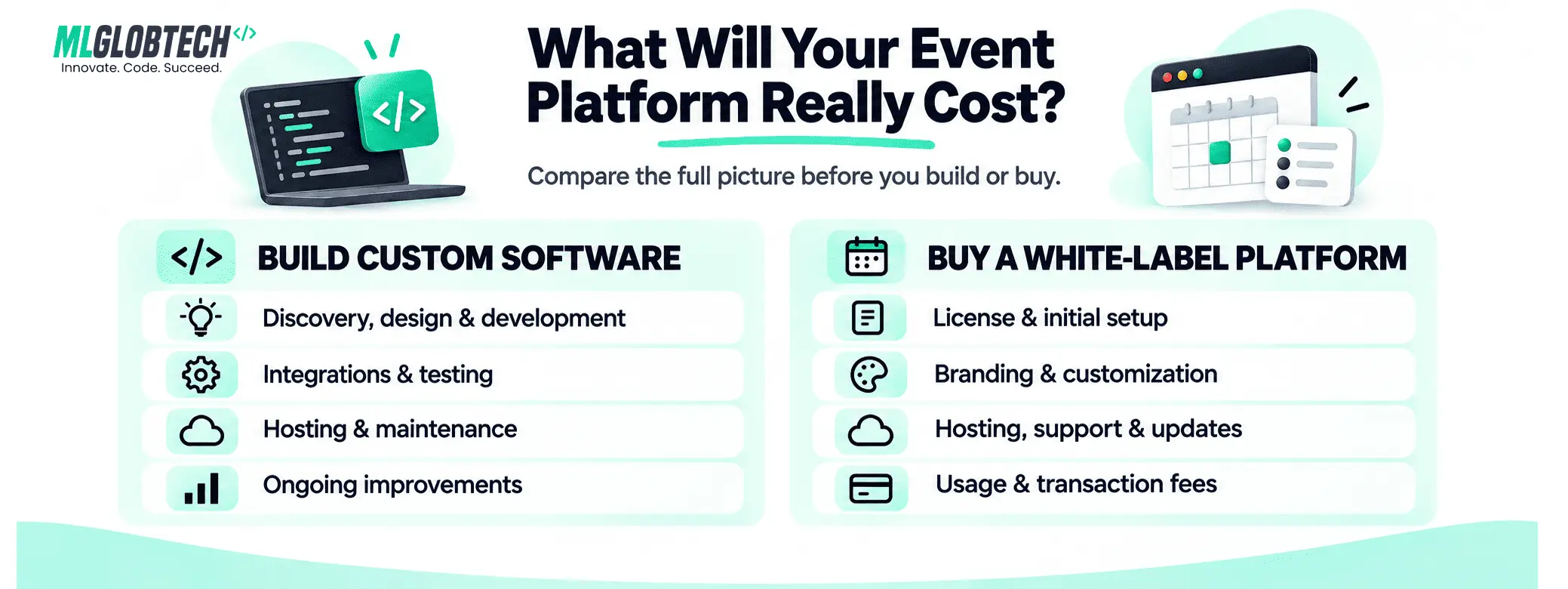
Building gives you room to create workflows around your business. Buying a white-label event management platform gives you software to evaluate, brand, and adapt before you commit to developing everything from scratch.
Neither option ends with the launch. Someone still needs to handle updates, payment exceptions, integrations, and support when an event is about to begin.
If you are deciding whether to build vs. buy event management software, compare what you will need to operate over the next three years, alongside what you need on day one.
Budget pressure makes that comparison timely. Cvent’s 2026 Global Planner Sourcing Report, based on 1,650 planners worldwide, found that 72% expected event costs to rise. This concerns overall event expenses, rather than software prices, but it explains why buyers need a clear business case for technology spending.
1. Event Management Software Cost: Build vs. Buy at a Glance
Custom development starts with your requirements and a development plan. A licensed platform starts with existing functionality that you assess against those requirements.
| Decision factor | Custom development | White-label platform |
|---|---|---|
| Starting point | A defined scope and new development | An existing software foundation |
| Initial spending | Discovery, design, development, testing | Licensing, setup, branding, modifications |
| Launch readiness | Depends on delivery and testing progress | Depends on product fit and implementation |
| Flexibility | Shaped by architecture, skills, and budget | Shaped by architecture and license terms |
| Ongoing work | Requires a maintenance and engineering plan | Requires clear vendor and customer responsibilities |
| Main concern | Underestimating the work after launch | Choosing software that needs extensive changes |
A close product fit can make buying attractive. If your essential workflows conflict with the software’s design, the modifications may remove much of that advantage.
Start by writing down five workflows the business cannot operate without. Use those workflows to evaluate both proposals.
2. What Does White-Label Actually Include?
White-label generally means software can be presented under an agreed brand. It does not automatically establish who owns the code, hosts the application, or controls future development.
A hosted subscription might include infrastructure, routine updates, and branding options. Your ability to change workflows or move the software elsewhere may be limited.
A source-code license may allow deployment on your infrastructure and modifications by your developers. Those rights still depend on the agreement. Access to code does not necessarily include exclusive ownership, unlimited installations, or unrestricted resale.
With custom development, ownership also needs attention. Establish what the developer transfers to you, which third-party components remain subject to separate licenses, and who controls infrastructure accounts.
Before comparing prices, ask each supplier to describe exactly what you receive. Otherwise, you may be comparing a managed service with a software license that leaves operations entirely to your team.
3. How Much Does It Cost to Build an Event Management Platform?
Event management software development cost depends on the workflows you need, the complexity of integrations, and the work required to test and support the finished product. A list containing “registration, payments, and reporting” leaves too many questions unanswered.
For a useful quotation, specify what happens in each workflow and ask the supplier to price the agreed scope. Also request the assumptions behind the estimate, including team responsibilities and how additional work will be approved.
Define the operating model first
A portal for one organizer differs from a marketplace serving independent organizers. The marketplace may need approval processes, separate dashboards, commission rules, payout records, and platform-level reporting.
Specify user roles, event types, currencies, expected traffic, and launch priorities. Ask the development team to identify assumptions and exclusions before agreeing to a price.
Follow a transaction through its full journey
A ticket purchase seems straightforward until something changes after payment.
Can an attendee transfer the ticket? What happens if the organizer cancels the event? Who approves the refund? If the organizer has already received a payout, how is that adjustment recorded?
These are illustrative requirements, not claims about any particular product. Walking through them helps uncover development work that a feature checklist may miss.
Include testing and handover
Your estimate should cover design, development, integrations, testing, deployment, and documentation. Agree on acceptance criteria for payments, access permissions, reporting, and peak registration traffic.
Include a handover plan. Another developer should be able to understand how to deploy and maintain the application without relying entirely on the original team.
4. White-Label Event Management Platform Cost: What’s Included?
A white-label quotation should separate the cost of accessing the software from the cost of making it ready for your business. Request a complete implementation proposal with recurring charges listed separately.
The advertised price might cover the standard product while excluding migration, workflow changes, integrations, or support outside normal business hours.
| Cost item | What to confirm |
|---|---|
| License or subscription | Included usage, domains, installations, and commercial rights |
| Branding | Logo, colors, domain, emails, and document templates |
| Customization | Included changes and rates for additional work |
| Integrations | Setup charges, third-party subscriptions, and maintenance |
| Infrastructure | Hosting, backups, monitoring, and scaling responsibilities |
| Support | Coverage hours, escalation process, and applicable limits |
| Usage | Charges per registration, organizer, transaction, or message |
| Updates | Upgrade access and compatibility with custom changes |
Ask what happens when your usage grows. A proposal that works for a pilot may become expensive at a larger registration volume.
Also distinguish platform transaction charges from payment processor fees. Both can affect margins, but they may come from different suppliers and follow different refund rules.
5. Build vs. Buy: Compare the Three-Year Cost
Compare each option using the same scope, expected volume, and service requirements. A basic hosted package and a fully customized development proposal are not equivalent offers.
Use this framework:
Three-year total cost = initial implementation + three years of recurring charges + planned enhancements + internal operating effort + transition costs.
Build a cost worksheet
| Cost category | Custom build estimate | White-label estimate |
|---|---|---|
| Initial implementation | Discovery through deployment | License, configuration, and launch work |
| Recurring operations | Infrastructure and maintenance | Hosting, subscriptions, and support |
| Enhancements | Planned engineering work | Vendor or developer change requests |
| Usage charges | Relevant third-party services | Platform fees and third-party services |
| Internal time | Product management and operations | Vendor management and operations |
| Transition | Migration and training | Migration, training, and potential exit work |
Populate this worksheet with quotations rather than generic industry averages. There is no single reliable price for every event platform.
For example, suppose one proposal includes hosting and updates while another requires your team to provide both. Add those missing costs before comparing the totals. If a feature is described as optional, ask for its price now rather than assuming it will be inexpensive later.
A fair event management software cost comparison also separates spending required to launch from improvements you can postpone. Keep the same launch scope on both sides so a more complete proposal does not appear expensive simply because it includes work the other supplier left out.
For usage fees, test the arithmetic. A hypothetical platform charge of $0.50 across 20,000 paid registrations would add $10,000 annually, before other charges. This is a calculation example, not Event ML pricing or a market benchmark.
Estimate low, expected, and high-volume scenarios. The best choice should remain affordable if adoption grows faster or slower than planned.
6. Launch Time and the Cost of Delays
A launch date means little without a description of what will be ready.
For custom development, request milestones for workflow approval, working functionality, integrations, testing, and release preparation. For licensed software, request an implementation schedule covering configuration, modifications, migration, and training.
An existing product can reduce work when its current features fit your requirements. Extensive changes can lengthen implementation, so test those assumptions before making customer commitments.
Think about the consequences of delay. Would it prevent you from serving a contracted event? Would your team continue using a costly manual process? Use those concrete effects when evaluating timing.
A controlled first event can be useful under either model. Test the complete journey with a limited audience before handling a major launch. Record problems, assign owners, and confirm fixes before increasing volume.
7. Customization, Source Code, and Ownership
Branding changes are easy to demonstrate. Structural changes require a closer look.
Ask suppliers to show how they would support an unusual approval rule, a different payout process, or an organizer-specific registration workflow. Find out whether the change uses standard settings, an extension, or a modification to the core application.
That distinction affects future maintenance. A modification may need additional testing or redevelopment when the underlying product changes.
Make independence practical
If source-code access is important, confirm that your team can actually use it. Ask about deployment instructions, dependency documentation, database access, and rights for an independent developer to maintain the software.
For data portability, request a sample export. Check whether it includes attendees, orders, refunds, consent records, and relationships between records where relevant.
Custom development can create dependency too. If only one person understands the application, changing suppliers may still be difficult. Clear documentation and shared access matter under both approaches.
8. Integrations, AI, and Reporting
The platform needs to fit the way your business handles customer information and follow-up.
Forrester’s Q1 2026 State of B2B Events Survey, covering more than 400 event decision-makers globally, found that two-thirds had integrated their primary event platform with their wider sales and marketing technology. [2]
Test what the integration actually does
Sending a registration email address to a CRM may be sufficient for a basic use case. More detailed workflows might require attendance status, session participation, transaction updates, and communication preferences.
Test duplicate records, failed transfers, and changes after registration. Establish which team handles a failure when two suppliers are involved.
Evaluate AI through a specific task
Ask what an AI feature helps someone accomplish, what data it needs, and how you will check its output. Drafting an event description and recommending sessions are different capabilities with different requirements.
The same Forrester research identifies data quality and accessibility as a barrier to AI-powered attendee personalization for 63% of respondents. Good data handling therefore belongs in the buying decision alongside AI features. [2]
Agree on useful reporting
Choose measures that match your business model: registration conversion, attendance, repeat participation, organizer retention, or ticket revenue where applicable.
Do not treat a dashboard as evidence that measurement is solved. Ask where the figures come from, when they update, and whether your team can export the underlying records.
9. Security, Scalability, and Support
A feature demonstration cannot establish how software will behave during a busy registration opening or an event-day incident.
Define who maintains application dependencies, controls administrator access, monitors infrastructure, and restores backups. Request evidence appropriate to your requirements rather than accepting a general claim that the platform is secure.
For performance, describe realistic scenarios. Hundreds of people browsing an event page create a different workload from hundreds completing payments simultaneously.
Ask how performance will be tested, what limits apply, and how capacity can increase. If internet connectivity is unreliable at a venue, discuss how your intended check-in process would work.
Support arrangements deserve the same attention. Confirm coverage hours, escalation contacts, and response expectations. A promise to acknowledge an issue does not establish when service will be restored.
Finally, identify who investigates custom-code issues. Your team should know whom to contact before an organizer calls with attendees waiting at the entrance.
10. When to Build, Buy, or Combine Both
Build when the distinctive requirements justify it
Custom development is worth considering when the workflows that make your business valuable are poorly supported by existing products, and you have resources for ongoing engineering.
You need more than an initial development budget. You need someone to prioritize improvements, maintain the system, and respond when dependencies change.
Buy when the foundation already fits
One benefit of white-label event management software is that you can assess existing workflows before commissioning major development.
If the core product fits, you can direct spending toward branding, integrations, and selected enhancements. Check that the commercial terms support how you intend to operate and sell the service.
Combine both when extensions are manageable
You may license a suitable foundation and develop specialist capabilities around it. This approach works best when APIs, extension points, and support boundaries are clear.
Before you build your own event management platform, compare that option with adapting an existing foundation. Equally, avoid buying software that needs most of its core behavior rewritten.
11. A Checklist Before You Commit
Use the same questions for every shortlisted option:
1. Can we test our essential workflows before approval?
2. What is included in the initial scope?
3. What will the platform cost at three different usage levels?
4. Which licensing and modification rights do we receive?
5. Who owns maintenance, integrations, and event-day support?
6. What evidence supports performance and backup arrangements?
7. Can we export our data and change providers?
Have the people responsible for finance, operations, and technical maintenance review the answers. Each may spot an assumption that a product demonstration overlooks.
If a requirement cannot be demonstrated yet, record it as an unresolved delivery item with a cost, owner, and acceptance test. That makes the final decision easier to defend.
Explore MLGLOBTECH Events for Your Event Business
Choose an approach you can operate after launch. A custom build needs an ongoing engineering plan. A licensed platform needs suitable functionality, clear terms, and dependable implementation and support arrangements.
Explore MLGLOBTECH Events by MLGLOBTECH and discuss your organizer model, integrations, expected registration volume, and launch plans. Request a walkthrough and an itemized proposal covering setup, any required modifications, recurring costs, deployment options, licensing rights, and support.
Bring the same cost worksheet you used for other suppliers. That gives you a practical basis for deciding whether MLGLOBTECH Events fits your budget and operating needs.
For an overview of the company’s offering, visit MLGLOBTECH’s white-label event management platform page.
Sources
[1] Cvent, “How Venue Sourcing Is Changing in 2026: Data From 1,650 Event Planners,” March 23, 2026. https://www.cvent.com/en/blog/events/venue-sourcing-trends
[2] Forrester, “The Next Era of B2B Events: Eight Data-Backed Shifts Defining 2026,” June 25, 2026. https://www.forrester.com/blogs/the-next-era-of-b2b-events-eight-data-backed-shifts-defining-2026/
Research checked October 17, 2026. Industry survey findings provide context and do not establish software prices or prove that one purchasing model delivers better results.