How to Choose the Right Quality Management System: Features, Automation, AI, and More

MLGLOBTECH
Oct 7, 2026
Choosing the right Quality Management System (QMS) is no longer simply about replacing spreadsheets or moving documents into a digital platform. Modern quality teams need to manage documentation, audits, non-conformances, corrective actions, risks, suppliers, training, approvals, and compliance while maintaining clear traceability.
At the same time, automation and artificial intelligence (AI) are changing how organizations manage quality information and workflows. The right solution should therefore do more than store records. It should help organizations create controlled processes, reduce repetitive work, improve visibility, and support better quality decisions.
The timing is also important. ISO 9001:2026 was officially published on September 16, 2026, replacing ISO 9001:2015. ISO says the new edition places greater emphasis on leadership, quality culture, risks and opportunities, and usability.
So, how do you choose the right Quality Management System?
This guide explains the key features to evaluate, how AI and automation are changing quality management, what ISO 9001:2026 means for your selection process, and how to evaluate QMS vendors before making a decision.
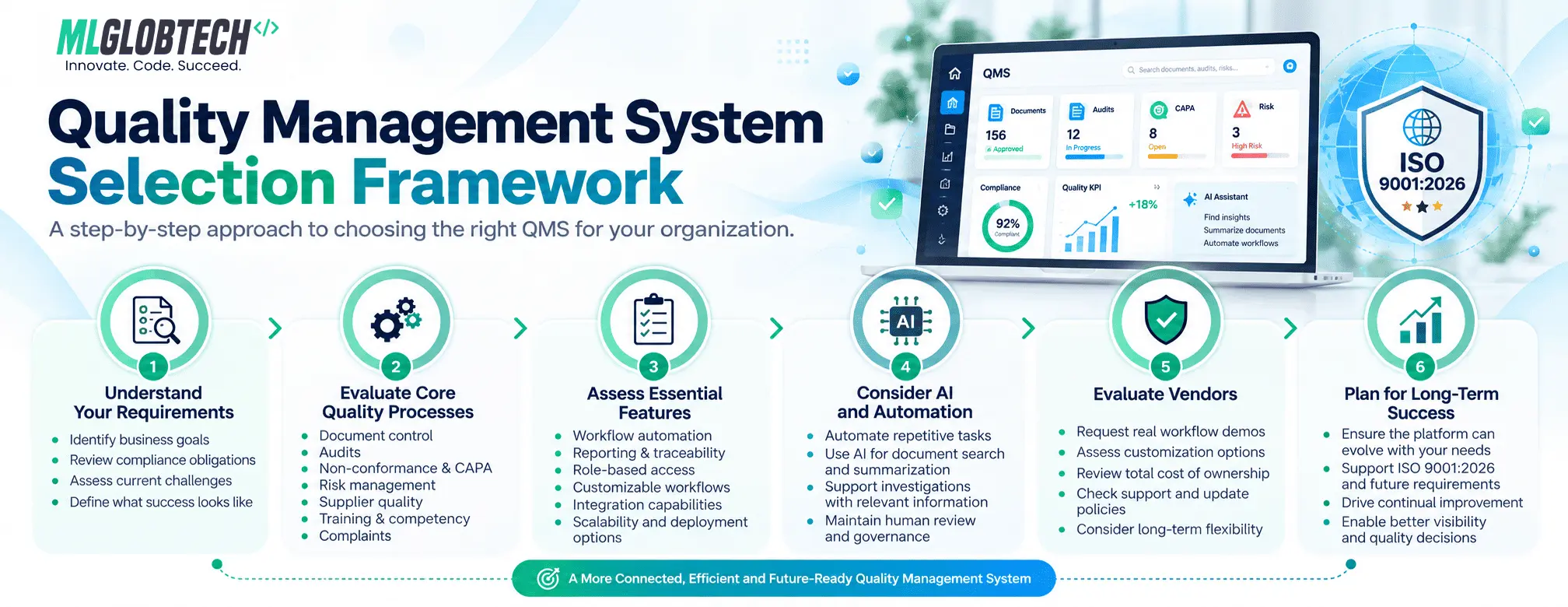
What Should You Consider Before Choosing a Quality Management System?
Before comparing vendors, start by understanding your organization's current quality processes.
A common mistake is to begin with a long list of software features and then try to determine which platform has the most features. A better approach is to identify where your existing quality processes are inefficient, difficult to track, or dependent on manual work.
Ask questions such as:
Which quality processes are still managed through spreadsheets or email?
How are controlled documents created, reviewed, approved, and revised?
How are audit findings tracked after an audit?
How are non-conformances and CAPA activities managed?
How are quality risks identified and reviewed?
How are supplier evaluations and certifications maintained?
How are employee training requirements tracked?
How are approval deadlines and recurring activities monitored?
How easily can quality managers access historical records and evidence?
Which processes need automation?
These questions help establish your actual requirements before you evaluate technology.
Look for connected processes, not isolated features
Quality activities rarely exist independently.
For example, an audit may identify a non-conformance. That non-conformance may require root-cause analysis and a corrective action. The corrective action may require evidence, verification, effectiveness review, and management approval.
If these activities are maintained in separate systems or spreadsheets, employees may need to duplicate information and manually connect records.
A more effective approach is to look for a system where related quality activities can be connected and traced throughout their lifecycle.
Consider the move from manual to intelligent quality management
Organizations typically progress through several stages:
Manual → Digital → Automated → AI-assisted
Digitization makes information easier to store and access. Automation reduces repetitive administrative work. AI can then help users search, summarize, generate, and analyze information.
The objective is not technology for its own sake. The objective is to create quality processes that are controlled, measurable, traceable, and easier to improve.
10 Essential Quality Management System Features to Evaluate
Different organizations have different requirements, but certain capabilities should be carefully evaluated when selecting a Quality Management System.
1. Document Control and Version Management
Controlled documentation is fundamental to quality management.
A suitable system should help organizations manage:
Document versions and revisions
Review and approval workflows
Digital signatures
Access permissions
Revision history
Audit trails
Document retention
Controlled distribution
Document search and retrieval
Version control is particularly important when employees rely on procedures, work instructions, policies, specifications, or other controlled documents.
The system should make it clear which version is currently approved and provide a reliable history of previous changes.
2. Audit Management
Audits generate information that should lead to action, not simply produce a report.
When evaluating audit capabilities, look for support for the complete audit lifecycle:
Planning → Audit → Findings → Actions → Evidence → Verification → Closure
Useful capabilities can include audit scheduling, customizable checklists or templates, evidence collection, findings management, scoring, assignments, notifications, reporting, and historical audit records.
It is also valuable when audit findings can be connected directly to non-conformances or corrective actions. This creates better traceability between what was identified and how the organization responded.
3. Non-Conformance and CAPA Management
Non-conformance and Corrective and Preventive Action (CAPA) processes are among the most important areas to evaluate.
A strong workflow should allow teams to record the issue, assess its severity, identify the root cause, define corrective or preventive actions, collect evidence, verify implementation, evaluate effectiveness, and formally close the activity.
A typical lifecycle can look like:
Issue → Containment → Root Cause → Corrective Action → Evidence → Verification → Effectiveness Review → Closure
The system should also provide visibility into overdue actions, responsible owners, historical activity, and supporting evidence.
The key question is not simply whether a platform has a “CAPA module.” Ask whether it supports the complete CAPA lifecycle and maintains a clear audit trail.
4. Risk Management
Quality management increasingly requires organizations to identify and respond to risks and opportunities.
When evaluating risk capabilities, consider whether the system supports:
Risk identification
Likelihood and impact scoring
Risk categorization
Controls
Mitigation actions
Ownership
Review and reassessment
Evidence
Historical records
Risk management should ideally connect with other quality processes rather than exist as a standalone register.
For example, a significant risk could lead to a corrective action, additional training, a supplier review, or a process change.
5. Supplier Quality Management
Supplier performance can directly affect product and service quality.
Organizations with complex supply chains should evaluate capabilities for managing:
Supplier profiles
Qualifications
Certifications
Supplier evaluations
Supplier audits
Performance history
Corrective actions
Supporting documentation
A centralized supplier quality process can make it easier to identify recurring supplier issues and maintain evidence for evaluations and audits.
6. Training and Competency Management
Quality processes are only effective when employees understand their responsibilities.
A QMS should therefore make it possible to manage training requirements, assignments, assessments, completion records, certificates, and expiry dates.
Important capabilities may include:
Training assignments
Courses and learning materials
Assessments or quizzes
Competency records
Certificates
Expiry notifications
Training history
Compliance reporting
Connecting training with controlled documents can also be useful. When a procedure changes, for example, organizations may need to determine whether affected employees require additional training.
7. Workflow Automation
Workflow automation can remove a significant amount of repetitive administrative work.
Instead of employees manually checking email or spreadsheets for the next step, predefined workflows can trigger activities such as:
Reviewer assignments
Approval requests
Notifications
Escalations
CAPA reminders
Audit follow-ups
Document reviews
Training expiry reminders
Recurring activities
The most important consideration is configurability.
Organizations should ask whether workflows can be adapted as processes change rather than being locked into predefined sequences.
8. AI Capabilities
AI is becoming an increasingly relevant consideration when evaluating quality technology.
However, organizations should distinguish between meaningful AI capabilities and simple features marketed as “AI.”
Useful applications can include:
Document generation
Document summarization
Intelligent search
OCR-based information extraction
Semantic search
Knowledge retrieval
Investigation assistance
Analysis of large volumes of quality information
AI can be especially valuable when employees need to locate information across large collections of SOPs, policies, procedures, reports, and historical records.
At the same time, AI should not remove human accountability from quality decisions. Organizations should evaluate how AI-generated information is reviewed, approved, controlled, and traced.
9. Reporting, Dashboards, and Traceability
A quality platform should make it easier to understand what is happening across the organization.
Useful reporting capabilities may include:
Quality dashboards
KPI tracking
Audit reports
CAPA status
Non-conformance trends
Risk reports
Training compliance
Supplier performance
Activity history
Approval records
Traceability is equally important.
A quality manager should be able to understand who performed an action, when it happened, what changed, who approved it, and what evidence supports the decision.
10. Customization, Integration, and Scalability
No two organizations manage quality in exactly the same way.
Therefore, evaluate how easily the system can adapt to your organization's processes.
Consider:
Configurable workflows
Custom forms
Role-based permissions
User and department structures
Integration capabilities
APIs
Reporting flexibility
Scalability
Deployment options
Data migration
Support and training
Upgrade policies
Customization becomes particularly important as quality programs mature. A platform that works for today's processes should not become a limitation when the organization expands or changes its operating model.
How AI and Automation Are Changing Quality Management
AI and automation are often discussed together, but they solve different problems.
Automation makes predefined processes happen automatically.
AI helps people work with information and make better-informed decisions.
For example, automation can automatically send a document for approval, notify an employee about an overdue CAPA action, or remind a manager about an upcoming review.
AI, on the other hand, can help summarize a long document, retrieve relevant information, identify related records, or assist with information-heavy investigations.
Where automation creates value
Automation is particularly useful for repetitive and rules-based activities:
Approval routing
Notifications
Reviewer assignments
Escalations
Recurring reviews
CAPA deadlines
Training reminders
Document review cycles
The benefit is not simply saving time. Consistent workflow execution can also reduce the risk of missed activities and improve process visibility.
Where AI can support quality professionals
AI can be useful when teams need to work with large amounts of unstructured or semi-structured information.
Potential applications include:
Summarizing quality documents
Generating initial document drafts
Searching across document collections
Extracting information from scanned documents
Finding relevant procedures or records
Supporting investigations
Identifying patterns in historical information
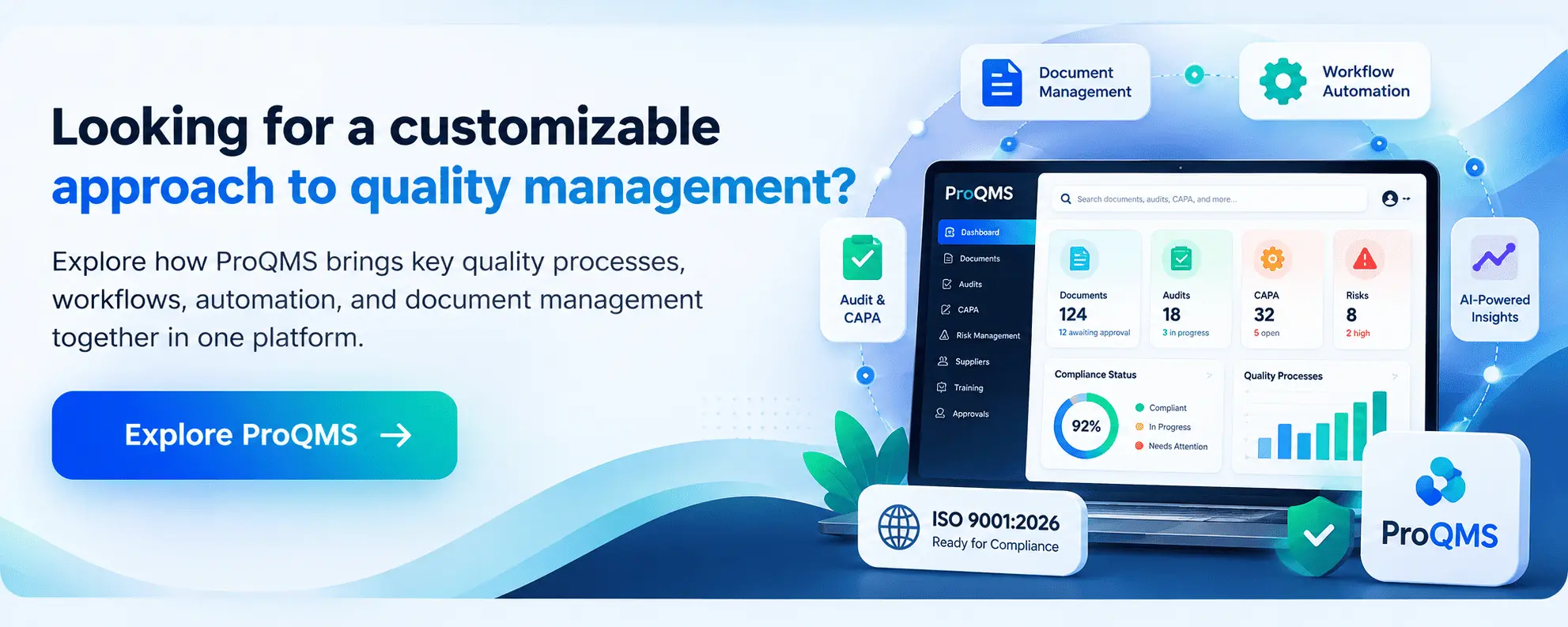
MLGLOBTECH takes this approach in ProQMS, combining workflow automation with AI-enabled document capabilities such as OCR-based search, semantic search, document summarization, and AI-assisted document generation.
The important consideration when evaluating any AI-enabled Quality Management System is not simply whether it has an “AI” label. Organizations should ask:
Can users review AI-generated results?
Are access permissions applied to AI searches?
Can important decisions be traced?
Is human approval required where appropriate?
Can administrators control AI functionality?
How is sensitive quality information handled?
The ideal model is:
AI assistance → Human review → Controlled approval → Traceable record
AI should make quality teams more efficient without making quality processes less controlled.
What Does ISO 9001:2026 Mean for QMS Selection?
ISO 9001:2026 was published on September 16, 2026, and is the current edition of the international quality management standard. ISO describes the revision as an evolution of the existing framework, with updates intended to improve clarity, usability, and relevance. The revised edition places greater emphasis on leadership, quality culture, risks and opportunities, and alignment with other management system standards.
ISO also states that more than one million ISO 9001 certificates have been issued in 189 countries, demonstrating the global importance of the standard.
For organizations selecting or upgrading technology, the revision is a useful reason to reassess whether existing quality processes are still fit for purpose.
What should organizations evaluate?
A QMS platform should help support processes related to:
Controlled documented information
Risk and opportunity management
Audits
Corrective actions
Training and awareness
Evidence and records
Approvals
Monitoring and measurement
Continual improvement
Traceability
However, software alone does not make an organization ISO 9001 certified. Certification depends on how the organization's management system is implemented and operated and, where applicable, assessed by an appropriate certification body.
ISO 9001:2026 transition timeline
For organizations already certified to ISO 9001:2015, the transition should be planned rather than treated as a last-minute software project.
ISO/TC 176 transition guidance states that accreditation bodies are expected to be ready to assess ISO 9001:2026 by March 31, 2027. From March 31, 2028, new and initial accredited certifications may only be issued to ISO 9001:2026, while organizations already certified to ISO 9001:2015 have until September 30, 2029 to complete their transition.
This makes 2026–2029 an important period for organizations to review their quality processes, documentation, technology, and transition plans.
How to Evaluate QMS Vendors
Once you understand your requirements, move from feature comparison to practical vendor evaluation.
A product demonstration can look impressive while revealing very little about how the platform will work in your actual organization.
1. Ask vendors to demonstrate a real workflow
Instead of asking for a list of features, provide a realistic scenario.
For example:
Audit Finding → Non-Conformance → Root Cause → CAPA → Evidence → Verification → Effectiveness Review → Closure
Ask the vendor to demonstrate how information moves through each stage.
This can reveal whether the platform genuinely connects processes or simply provides separate modules.
2. Evaluate customization
Ask:
Can workflows be changed?
Can forms and fields be configured?
Can roles and permissions be customized?
Can new workflows be created?
Can processes change without extensive development?
Customization is especially important for organizations with industry-specific or complex quality procedures.
3. Evaluate AI carefully
Do not evaluate AI based solely on the presence of a chatbot or “AI-powered” label.
Ask what the AI actually does, what information it can access, how permissions are applied, whether users can review its output, and how AI-assisted activities are documented.
4. Calculate the total cost of ownership
The purchase price is only one part of the investment.
Consider:
Implementation
Customization
Data migration
Integrations
User training
Support
Maintenance
Upgrades
Additional development
A lower initial price does not necessarily mean a lower long-term cost.
5. Consider long-term ownership and flexibility
Your quality requirements will change.
Therefore, evaluate how much control your organization has over the platform and what happens when you need new workflows, integrations, reports, or custom functionality.
Why ProQMS by MLGLOBTECH Is a Strong Choice
After evaluating the capabilities above, organizations can compare individual platforms against their specific requirements.
ProQMS by MLGLOBTECH is designed around connected quality processes rather than treating each quality activity as an isolated function.
The platform brings together areas such as:
Document control
Audit management
Non-conformance management
CAPA
Risk management
Supplier quality
Training and competency
Workflow automation
AI-enabled document capabilities
One of its notable differentiators is complete source-code access, which can be particularly relevant for organizations that require significant customization or want greater control over how their platform evolves.
The platform also combines configurable workflows with AI-enabled document capabilities, including document generation, summarization, OCR-based search, and intelligent information retrieval.
For organizations evaluating a QMS, these capabilities are most relevant when they match actual operational requirements. The strongest platform is not necessarily the one with the longest feature list; it is the one that can support the organization's processes, users, compliance requirements, and future growth.
Organizations considering ProQMS should therefore evaluate it against their own workflows, integration requirements, customization needs, AI governance expectations, and long-term ownership model.
Frequently Asked Questions
What is a Quality Management System?
A Quality Management System is a structured framework of processes, responsibilities, procedures, records, and controls that organizations use to manage quality and support continual improvement. A digital QMS can help organizations manage these activities through centralized workflows, records, automation, and reporting.
How do I choose the right Quality Management System?
Start by identifying your current quality processes and pain points. Then evaluate essential capabilities such as document control, audits, CAPA, non-conformance, risk, supplier quality, training, workflow automation, reporting, customization, and integration. Finally, test vendors using realistic workflows rather than relying only on feature lists.
What features should a Quality Management System have?
Important capabilities typically include document control, audit management, non-conformance and CAPA management, risk management, supplier quality, training, workflow automation, reporting, traceability, permissions, customization, and integration.
The exact requirements depend on the organization's industry, size, processes, regulatory environment, and quality objectives.
How does AI help a Quality Management System?
AI can help quality professionals search and summarize documents, generate content, retrieve relevant information, extract information from scanned documents, and support information-intensive investigations. AI should generally operate as an assistive capability with appropriate human review and governance.
How does automation improve quality management?
Automation can reduce repetitive manual work by routing approvals, assigning activities, sending notifications, escalating overdue tasks, scheduling recurring reviews, and reminding users about deadlines. This can improve consistency, visibility, and process efficiency.
How does ISO 9001:2026 affect QMS selection?
ISO 9001:2026 provides an opportunity for organizations to review whether their quality processes and technology remain fit for purpose. When evaluating technology, organizations should consider how effectively it supports controlled documentation, risk and opportunity management, audits, corrective actions, training, evidence, traceability, and continual improvement.
When must organizations transition to ISO 9001:2026?
Organizations currently certified to ISO 9001:2015 have until September 30, 2029, according to ISO/TC 176 transition guidance, to complete the transition to ISO 9001:2026. New and initial accredited certifications may only be issued to ISO 9001:2026 from March 31, 2028. Organizations should work with their certification body to establish an appropriate transition plan.
Why should organizations consider ProQMS?
ProQMS may be a strong option for organizations looking for connected quality workflows, configurable processes, AI-enabled document capabilities, workflow automation, and greater control over customization through source-code access. The right choice should ultimately depend on how well the platform matches the organization's specific quality processes and long-term requirements.
Final Thoughts
Choosing a Quality Management System should not be a competition over the number of features.
The better approach is to evaluate whether a platform can help your organization:
Connect quality processes → Automate repetitive work → Improve traceability → Use AI responsibly → Adapt as requirements change
The arrival of ISO 9001:2026 makes this evaluation particularly timely. Organizations have an opportunity not only to prepare for the new standard but also to reconsider whether their existing quality processes, technology, and workflows are supporting the way the business operates today.
The right QMS should ultimately make quality management more controlled, more visible, more efficient, and easier to improve.
If you are evaluating a platform that combines connected quality workflows, automation, AI-enabled document capabilities, and customization, you can learn more about ProQMS by MLGLOBTECH.