Why a Document Management System Is Better Than Traditional File Management

MLGLOBTECH
Sep 1, 2026
Businesses handle thousands of documents every day, including invoices, contracts, reports, employee records, customer files, policies, and confidential business information. Traditionally, these documents have been managed using physical files, desktop folders, shared drives, and email attachments.
While traditional file management may work for a small amount of information, it becomes increasingly difficult as a business grows. Finding documents takes longer, duplicate files accumulate, security risks increase, and employees spend valuable time managing files instead of focusing on productive work.
A Document Management System (DMS) provides a smarter and more organized approach. With a centralized platform such as the MLGLOBTECH Document Management System, businesses can store, organize, search, manage, and secure documents from a single system.
What Is Traditional File Management?
Traditional file management involves storing documents in physical filing cabinets, computer folders, network drives, USB devices, or shared cloud folders.
For example, a company may have folders such as:
Finance
HR
Sales
Projects
Customers
Contracts
Reports
As the number of files increases, this structure can become difficult to maintain. Employees may save different versions of the same document in different locations, making it difficult to determine which file is the latest.
Email attachments can create another problem. Important documents may remain inside individual inboxes instead of being stored in a centralized location where authorized employees can easily access them.
What Is a Document Management System?
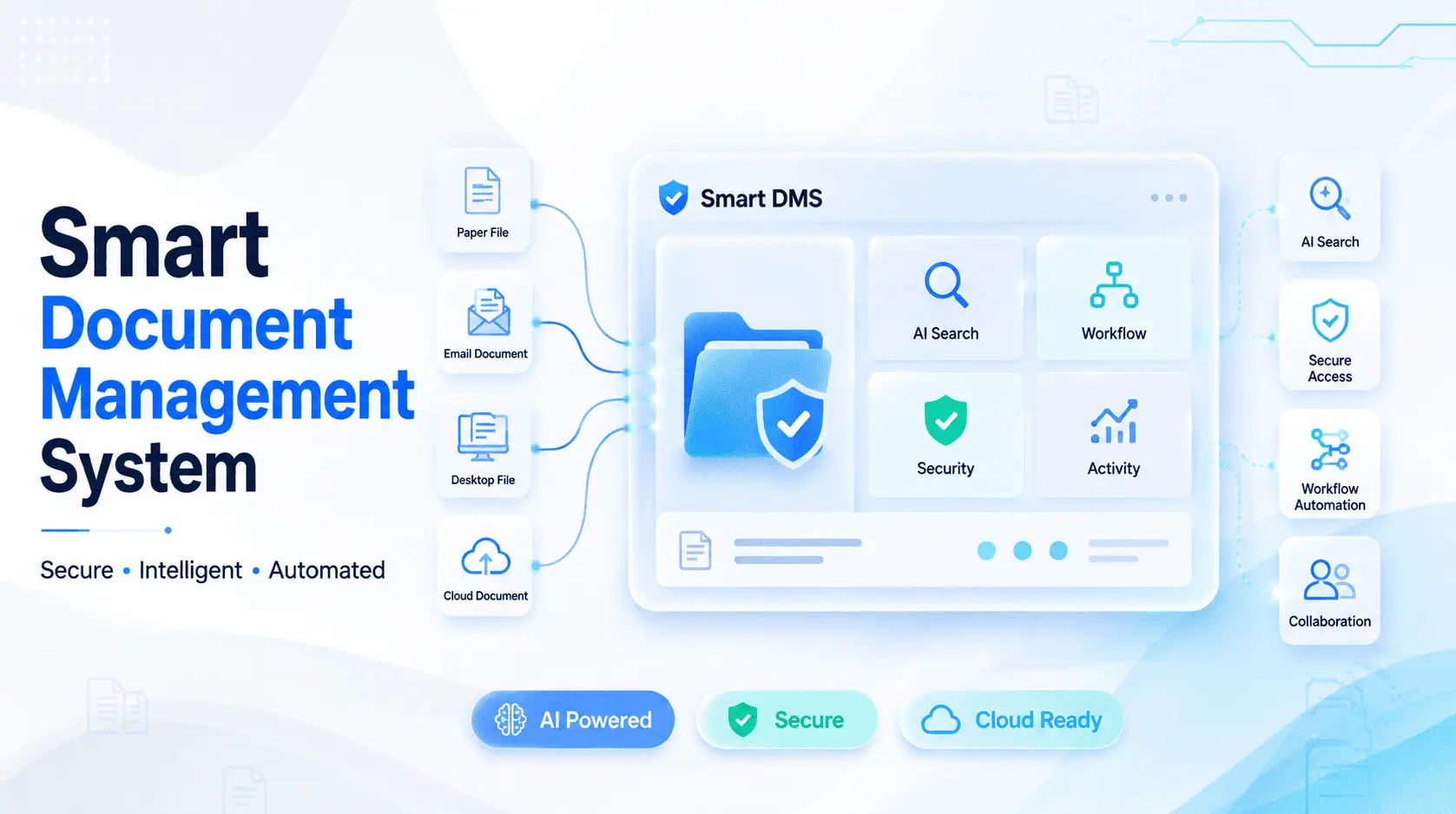
A Document Management System is software designed to digitally organize and manage business documents throughout their lifecycle.
Instead of relying on multiple folders, email attachments, and physical files, a DMS provides a centralized repository where documents can be stored and managed efficiently.
A modern DMS can provide features such as:
Centralized document storage
Advanced document search
Folder and category management
Document version control
Access permissions
Secure file sharing
Document preview
Metadata management
Audit trails
Backup and recovery
OCR-based document processing
User and role management
The goal is simple: make business documents easier to find, manage, share, and protect.
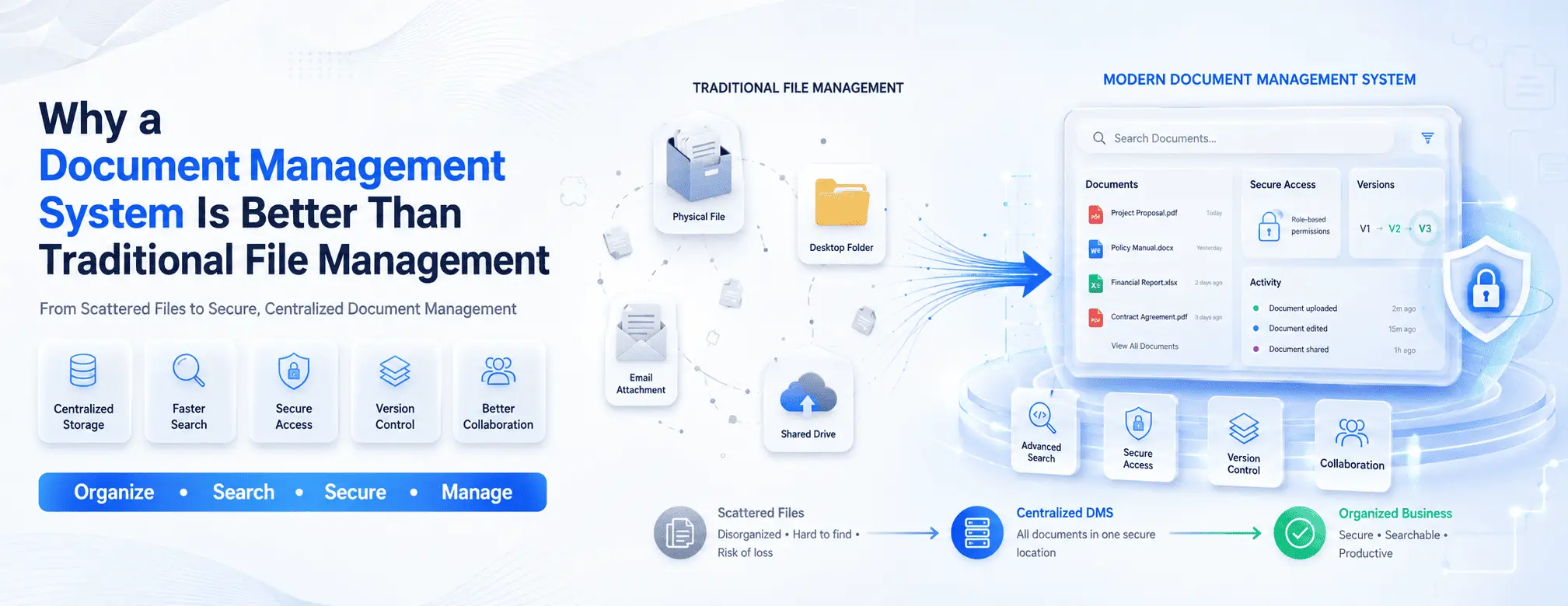
DMS vs Traditional File Management
1. Faster Document Search
One of the biggest disadvantages of traditional file management is the time employees spend searching for documents.
With traditional folders, users may need to open multiple directories and remember where a file was saved.
A DMS provides centralized and advanced search capabilities. Users can search documents using keywords, categories, metadata, document names, or other available information.
This can significantly reduce the time spent looking for important business documents.
2. Centralized Document Storage
Traditional file management often results in documents being scattered across computers, email inboxes, network drives, and physical storage.
A DMS brings documents into a centralized repository.
With MLGLOBTECH Document Management System, businesses can create a structured digital environment where documents are organized and accessible according to user permissions.
This makes it easier for teams to locate the information they need without searching through multiple storage locations.
3. Better Document Security
Security is another major difference between traditional file management and a dedicated DMS.
A shared folder may give users more access than they actually need. Sensitive documents can potentially be copied, moved, or shared without proper control.
A DMS can provide role-based access and permissions, allowing organizations to control who can view, edit, download, or manage specific documents.
This is particularly useful for organizations handling confidential financial information, employee records, customer data, contracts, and internal business documents.
4. Version Control
Managing document versions manually can create confusion.
For example, different employees may have files named:
Contract_Final.docx
Contract_Final_Updated.docx
Contract_Final_New.docx
Contract_Final_Latest.docx
Which one is actually the latest version?
A DMS can provide version management, helping teams maintain document history and reduce confusion between multiple copies.
Employees can work with the appropriate version while maintaining a record of previous changes where supported.
5. Improved Collaboration
Traditional file management can make collaboration difficult, especially when employees work from different locations.
A centralized DMS enables authorized users to access business documents from a common platform.
Teams can share documents more efficiently while maintaining appropriate access controls.
This can help reduce unnecessary email attachments and improve collaboration between departments.
6. Reduced Paper and Manual Work
Physical document management requires printing, filing, copying, scanning, and manually organizing paperwork.
Apart from consuming time, physical storage also requires office space.
Digitizing documents through a DMS can help organizations reduce dependence on paper-based processes.
With technologies such as OCR (Optical Character Recognition), businesses can also extract searchable information from scanned documents, making previously difficult-to-search files easier to retrieve.
Why Businesses Should Move Beyond Traditional File Management
Traditional file management is not necessarily wrong. It can be suitable for individuals or very small teams with limited documentation.
However, as businesses grow, the number of documents, users, departments, and processes also increases.
This creates challenges such as:
Duplicate documents
Lost or misplaced files
Difficult document searches
Unauthorized access
Outdated document versions
Excessive email attachments
Manual document handling
Limited visibility into document activity
A DMS addresses many of these challenges by providing a structured and centralized environment for document management.

How MLGLOBTECH Helps Businesses Manage Documents
MLGLOBTECH provides technology solutions designed to help businesses simplify their digital operations.
Its Document Management System helps organizations move from scattered and inefficient file storage toward a more centralized document management environment.
Businesses can organize documents, improve search and retrieval, manage access permissions, and streamline document-related workflows from a single platform.
For organizations looking to reduce document chaos and improve productivity, implementing a DMS can be an important step toward digital transformation.
Conclusion
Traditional file management may seem simple, but it becomes increasingly inefficient as a business grows. Scattered files, duplicate versions, security concerns, and slow document searches can reduce productivity and create unnecessary operational challenges.
A Document Management System provides a more organized, secure, and scalable alternative.
Frequently Asked Questions
1. What is a Document Management System?
A Document Management System (DMS) is software that helps businesses securely store, organize, search, manage, and share digital documents from a centralized platform.
2. How is a DMS better than traditional file management?
A DMS offers faster document search, centralized storage, access control, version management, improved collaboration, and better document security compared with traditional folders and physical files.
3. Can a Document Management System improve business productivity?
Yes. A DMS reduces the time employees spend searching for documents and minimizes manual file management, allowing teams to focus on more productive tasks.
4. Is a Document Management System secure?
Modern DMS solutions can provide role-based access, permissions, audit trails, and controlled document sharing to help protect sensitive business information.
5. Why choose MLGLOBTECH for Document Management?
MLGLOBTECH's Document Management System helps businesses centralize documents, improve search and retrieval, manage access, and streamline document management through a digital platform.